
Each award is highlighted in the 2026 Minnesota Pork Congress magazine. Read the full magazine here.
This award is sponsored by Minnesota Pork Producers Association.
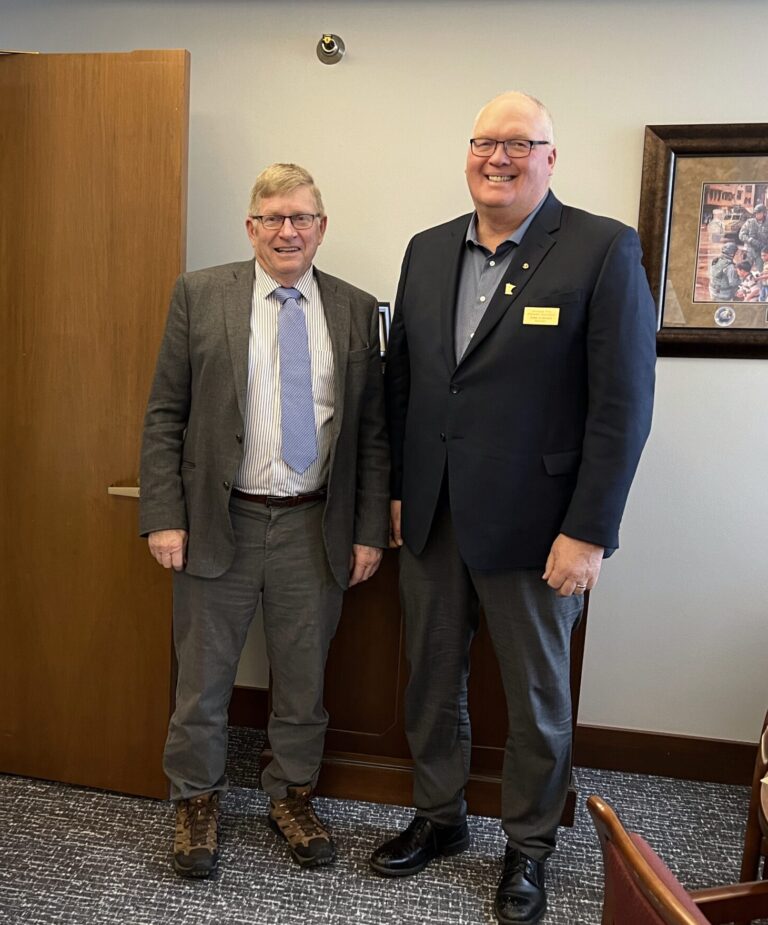
The Minnesota Pork Board recognizes Representative Paul Anderson as this year’s Legislator of Distinction award recipient.

For Representative Paul Anderson, agriculture is not simply a policy focus. It is the foundation of his life, his values and his approach to public service. As the recipient of the Minnesota Pork Legislator of Distinction award, Anderson is recognized for nearly two decades of leadership at the Minnesota Capitol and his unwavering commitment to ensuring agriculture has a strong, informed voice in state government.
Throughout his legislative career, Anderson has been known as a steady, practical leader who listens first, works across differences and approaches policy with the same mindset he brings to the farm: think long-term, solve problems, and do what is right.
Grounded in Rural Minnesota
Anderson grew up in Starbuck, Minnesota and is a fourth-generation farmer on his family’s farm. After graduating from Starbuck High School, he earned a Bachelor of Arts degree in physical education and education from the University of Minnesota, Morris. Agriculture has been a constant presence throughout his life, shaping not only his career but his perspective on stewardship, responsibility and community.
After college, Anderson spent time working as a radio announcer and sports broadcaster, a role that kept him closely connected to rural communities across west-central Minnesota. For more than 20 years, he served as a sports announcer and referee, experiences that reinforced the importance of communication, fairness and teamwork. These are skills that would later serve him well in public office.
In the mid-1970s, Anderson returned home to the family farm, where the operation includes corn, soybeans, small grains and beef cattle. Over the years, he has seen firsthand how advances in technology and management have allowed farmers to become more efficient while remaining committed to conservation and animal care.
“Today’s technology in agriculture allows farmers to be more efficient for a financial reason, but also for environmental reasons,” Anderson said. “Producers are always looking for ways to do things better.”
Alongside his wife, whom he often describes as his “right hand”, Anderson values the teamwork required to run a successful business. Their family remains closely connected to agriculture, with children and grandchildren continuing to stay involved and return home for planting and harvest when possible.
“Farming teaches you to think long term,” Anderson said. “You make decisions knowing they affect not just today, but the next generation.”

A Path to Public Service
Anderson’s path to public office began at the local level, driven by a desire to serve his community and make a positive impact. He spent 20 years as a township clerk, served on the local school board and later as a county commissioner, experiences that gave him a deep understanding of how government decisions affect people at every level.
In 2008, Anderson was elected to the Minnesota House of Representatives. Now in his 18th year in the House through three rounds of redistricting, he said his motivation for serving remains unchanged.
“I’ve always been interested in helping people,” Anderson said. “Government impacts everyone’s lives, and I’ve always believed it should work in a practical, common-sense way.”
Over the years, Anderson has witnessed agriculture policy become increasingly complex and, at times, more partisan. He notes that as fewer legislators come from farming backgrounds, it becomes even more important to educate colleagues about how policies translate to real-world impacts on farms.
“A lot of people don’t fully understand agriculture,” he said. “That’s why it’s important to keep those conversations going and make sure decisions are made with good information.”
That commitment to education and accessibility is part of what has made Anderson an effective advocate for pig farmers, said AJ Duerr, lobbyist for the Minnesota Pork Producers Association.
“Throughout his 18 years in the Minnesota House, Rep. Anderson has consistently championed legislation on behalf of pig farmers,” Duerr said. “As a farmer himself, he understands these issues better than just about anyone, and that credibility allows him to be effective whether he is chairing a committee or serving in the minority party. Whenever MPPA contacts him with a question or concern, his response is always immediate and extremely helpful.”

A Steady Voice for Agriculture
Throughout his legislative career, Anderson has been a consistent advocate for farmers and ranchers in Minnesota. He currently serves as co-chair of the House Agriculture, Finance, and Policy Committee, a role that allows him to bring firsthand farming experience into policy discussions and ensure agriculture remains part of broader state conversations.
He has worked on a wide range of agriculture-related legislation, including efforts to prevent bans on treated seed, address nuisance lawsuits affecting livestock producers and ensure statewide zoning and environmental protections are implemented fairly.
“We can protect natural resources and still allow farmers to do their jobs,” Anderson said. “Those things don’t have to be in conflict.”
Anderson also points to his work improving auditing requirements for small grain elevators and addressing permitting timelines as examples of practical changes that reduce unnecessary burdens while maintaining accountability.
“Permitting in Minnesota can be more difficult than in other states,” he said. “If timelines drag out too long, it discourages expansion and innovation. We need to make sure the process is fair and reasonable.”
From a policy perspective, Lauren Servick, director of public policy strategy and sustainability for the Minnesota Pork Producers Association, says Anderson’s approach to issues like environmental permitting reflects his ability to work through complex and often partisan topics.
“Representative Anderson remains a steady champion for the issues that directly impact farmers and rural Minnesota,” Servick said. “He has supported and advocated for reasonable changes that meet the needs of farmers in areas like environmental permitting, where things can get more partisan. Rep. Anderson is known for being level-headed and thoughtful, and that leadership and approach help agriculture issues move forward at the legislature.”

Committee Leadership and Legislative Impact
In addition to his leadership on agriculture issues, Anderson has served on numerous committees, including education, property tax, state and local government, and health policy.
He has played a role in updating the agricultural homestead tax classification to better reflect modern farming operations and supported increased funding for soil and water conservation programs, recognizing the importance of voluntary, incentive-based conservation efforts.
Anderson has also been a strong supporter of animal health and biosecurity initiatives. He has worked to maintain funding for the Minnesota Board of Animal Health and supported policies that strengthen disease prevention and response.
One issue Anderson continues to highlight is the shortage of rural veterinarians. He has supported loan forgiveness programs aimed at encouraging veterinarians to practice in rural areas, understanding the critical role veterinary care plays in livestock production.
“Animal health is essential,” Anderson said. “If we don’t have the infrastructure in place, it affects farmers, animal care and the food supply as a whole.”
Partnerships That Matter
Anderson credits strong relationships with farmers, commodity groups and fellow legislators as a key reason for his effectiveness. He has worked closely with Minnesota Pork leaders and advocates, including former Minnesota Pork CEO Dave Preisler, lobbyist AJ Duerr and pig farmer John Anderson, to gain a deeper understanding of the challenges facing pig farmers and livestock producers.
“These partnerships matter,” Anderson said. “The more communication we have, the better policy we create.”
Pig farmer John Anderson, who farms near Belgrade, Minn., has seen that approach firsthand and says it reflects the quiet confidence Rep. Anderson is known for.
“Paul’s quiet, confident demeanor has made him an effective leader in the Minnesota Legislature,” John Anderson said. “He understands the needs of his constituents by staying involved in the agriculture and community he represents.”
Why He Continues to Serve
Despite long legislative sessions and increasing demands, Anderson says he continues to serve because the work remains meaningful.
“I enjoy working with smart, talented people and helping solve real problems,” he said. “People call because they need help, and being able to help them is incredibly rewarding.”
He also emphasizes the importance of ensuring production agriculture continues to have a place at the table as policy discussions evolve.
“There is room for all of us,” Anderson said. “We need to make sure production agriculture has a voice and that decisions are made with a full understanding of the consequences.”

Advice for the Next Generation
When asked what advice he would offer to those involved in policymaking and advocacy, Anderson points to the importance of listening and collaboration.
“There are always two sides to an issue,” he said. “You need to hear both, discuss it and come to a common-sense solution. Do the right thing, the best thing.”
He also encourages agriculture to continue telling its story clearly and consistently.
“There are reasons why we do things the way we do,” Anderson said. “They make sense. We need to keep explaining that and helping people understand where their food comes from.”
Rep. Paul Anderson’s leadership, experience and commitment to agriculture have made a lasting impact at the Capitol and across Minnesota’s farming communities. As a Legislator of Distinction, his work continues to strengthen the partnerships and policies that support farmers today and into the future.